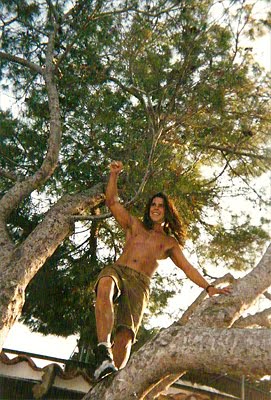
Light & Love
Andreas Nitschmann was one of those rare people who walked into a room and made it brighter. Born on 29 July 1967, he lived a life that refused to fit into a single box: actor, fighter, friend, animateur, teacher, son and brother — and, above all, a free spirit. He was at home between Berlin, London and the island of Ibiza, and everywhere he went he was known by many loving names — Opa, Guvna, Andy, N-Mann. He was warmly multilingual, and he used every language he knew to make people feel seen. On 10 October 2009 his light stepped into an even brighter one — but it never went out.
The Actor
On screen and on stage, Andreas Nitschmann gave every role his whole heart — he never disappeared behind his characters, he filled them with his own humanity. His love of performing was born under the sun of Ibiza, where as a holiday-club animateur he lit up the evening musicals: unforgettable as Frank N. Furter in the Rocky Horror Picture Show (1993–1995), as Death in Elisabeth (1995) and as the innkeeper in Les Misérables (1996). That spark would carry him, years later, all the way to Berlin.
In November 2002 he made the bravest decision of his life and moved to Berlin to chase his greatest dream. He paid for private acting, voice and singing lessons and trained specially for camera work — financing it all by giving city tours in German, English and Spanish, mixing cocktails and waiting tables in the city's finest houses. He worked the Austrian and Swiss embassies, always happiest back at his beloved Cafe Avril in Kreuzberg.
Between 2003 and 2007 he stood in front of the camera for short and feature films — from a soldier in K7B to the gangster in Killerbus (2003, directed by Marc Fehse), the lead in Abriss (Medieninstitut der Hochschule Mittweida) and the inspector in Der Fall Farid. In 2008 came his breakthrough: in the black comedy Criminal Hearts by the American playwright Jane Martin he played Robbie, performed in Berlin and Vienna with the Society Players / theater hautnah e.V., an actors' company he had helped to found. He took further roles in 4 Rules and, in 2009, starred as a quiet dreamer in the poetic film In Dreams. That same summer his short film Post Scriptum, made with a Berlin film school, premiered in the great CineMaX cinema. Represented by acting agencies in London and Berlin, Andy had done it: he had become a serious actor.
He was a natural linguist, too. German was his mother tongue, yet he spoke fluent English, the Spanish he had learned on Ibiza and the Italian that stayed with him from his time in Italy — and when the mood took him, his German warmed into Berlin dialect. He even spoke sign language. And when words ran out entirely, his body said the rest — a broad grin, an arm flung warmly around a shoulder, the quiet mischief in his eyes and the easy gentleness of a man as strong as he was tender. It was proof of something simple and beautiful: Andy could truly speak with anyone.
The Fighter
Alongside the artist lived a fighter — and Andreas was every inch of one. For decades he lived by the disciplines of self-defence, karate, boxing and kickboxing, a devotion that ran unbroken from his earliest childhood to his very last days. It began on the mats of the Budokan in Braunschweig, was tempered in the ring of the Boxtempel in Berlin and forged harder still at the Strikezone in Dortmund. Yet for Andy raw strength was never the point. What he pursued was mastery of himself — discipline, respect, and that rare, roaring stillness he called "the Zone", the place where body and soul at last moved as one.
His conditioning was world-class — the stuff of quiet legend. On Ibiza he thought nothing of cycling twenty-five kilometres to a building site at first light, working ten hard hours beneath the sun, then riding the whole way home again. And however wild the night before, he would rise and run ten kilometres alongside the holiday guests at ten the next morning, laughing, tireless, unbreakable. For years he trained at a Berlin kickboxing school, where his fire and his heart earned him the trust to coach the youth squad — and where, at the very last, he stood just one step from his trainer's licence.
Through it all walked his brother-in-arms, his friend and kickboxing teacher Pierre Konz. Their world reached its summit at K-1 Stars Live, a workshop of the elite, where Andy's path crossed that of the three-time K-1 world champion Remy Bonjasky, "the Flying Gentleman". But even at his most fearless, Andy never fought out of anger. He fought for focus, for freedom, for the sheer, blazing joy of movement — the very same fire he carried onto the dancefloor and the stage. In the ring as in life, he gave everything and held nothing back.
The Island — Space Ibiza
And then there was Ibiza, the island that gave him his most beloved name. His island story began in the summer of 1993, when he flew in from Berlin to work as a pool and sports animateur at the Punta Arabí holiday club. And it was here, in the evening shows beneath the stars, that he first discovered the stage.
He fell in love with the real island — not the postcard, but the living, breathing Ibiza. That first winter he made his home in a small stone house near San Carlos (Sant Carles de Peralta), in the green, unhurried north of the municipality of Santa Eulalia, sharing it with his dear friend Susana and her two dogs, Coffee and Frida. An adventurous dirt camino climbed all the way up to the house from Es Canar on the coast — a rough, beautiful track that felt like crossing a threshold into a wilder, freer world. And just along the quiet country road he found a place that would become another home: Bar Toni Curreu.
It is a hidden local gem, tucked off the winding road between Santa Eulalia and San Carlos — the turning so easy to miss that only those in the know ever find it. There is no velvet rope here and no show; just a rustic country terrace, sun-bleached wood, honest Spanish home cooking and tapas, and the warm murmur of islanders who have eaten here for years, long before the smart restaurants ever arrived. Named after the Curreu family land it stands on, it is the kind of unpretentious country bar where a stranger is welcomed like an old friend and the whole world falls, gently, into place. Push open its door and you feel it at once — this is the Ibiza that tourism forgot, and you never quite want to leave.
For Andy, this bar was home. Year after year he lingered here over countless cafés con leche and fresh bocadillos, and its owner Juan became a friend for life. In this easy, golden corner of the island he found the very thing he had always been searching for — a place that asked nothing of him and gave him everything: belonging, warmth, and the slow rhythm of days lived to the full. If you ever want to taste the Ibiza that Andy loved, this is where you begin.
And Andy was never a man of a single home. He felt just as easy and welcome down at the Flamingo Bar in Es Canar, over at the Milestone, and at the beloved village institution Bar Anita in the heart of San Carlos (Sant Carles de Peralta) — wherever there were friendly faces, an honest kitchen and a corner to call his own, he simply belonged.
And that same quiet corner of the island keeps its own kind of magic after dark. Barely two kilometres down the road, the lanterns of Las Dalias — the legendary San Carlos hippy market — flicker to life, and with them the free, bohemian spirit of Akasha, the club woven into Las Dalias, where nights like Sven Väth's T.R.A.N.C.E, Hernán Cattáneo, Supernova and Tales of the Unexpected still carry dancers from across the island deep into the small hours. It is the barefoot, open-hearted north that Andy carried in his bones — the Ibiza where a stranger at dusk becomes a friend by dawn.
His work carried him across the seas: a winter as an animateur on Tenerife, and the great adventure of the winter of 1995/96 in Costa Rica, where he became chief animateur of a five-star club, hosted the "Miss Costa Rica" contest, skydived from 5,000 metres and met the actor Bud Spencer in person. Back on Ibiza he became day chief at Punta Arabí and chief animateur of the Club Delfin, loved by guests from every corner of the world.
The Ibiza Andy loved was, of course, also the clubbing capital of the world, and he celebrated across its greatest temples of the night — Space, Pacha and Amnesia chief among them. No name has shone longer than Pacha. Founded in 1973 by Ricardo Urgell and crowned with its famous cherry, it is Ibiza's original super-club: a glamorous maze of five rooms where a single night can carry you anywhere. There is the pounding Main Room for house and techno, the soulful Funky Room with its disco, funk and soul, the experimental Global Room (the club's very first dancefloor, back in 1973), the star-lit Roof Terrace, and the retro Sweet Pacha for the hits of the eighties and nineties. Its legendary Flower Power nights, carried for decades by residents like Joan Ribas and DJ Piti, and residencies from giants such as David Guetta, Roger Sanchez, Erick Morillo, Solomun and Marco Carola's Music On, have made it a true temple of the Balearic night.
Out towards San Rafael stands Amnesia, the very birthplace of the Balearic beat. Opened in the mid-1970s by the philosopher Antonio Escohotado as a refuge he named for forgetting the world's troubles, it became legend when the Argentine DJ Alfredo began mixing rock, soul, funk and house with no borders at all — a freestyle sound that visiting British DJs carried home to ignite the acid-house revolution. Its two great spaces, the enclosed Main Room and the open-air Terrace — where the Ibiza sunrise breaking over the dancefloor is one of the true wonders of the clubbing world — have blazed through its famous foam parties, the joyous La Troya, the trance of Cream and, from 1999, Sven Väth's mighty Cocoon.
And towering above them all in sheer scale rises Privilege — once the legendary Ku, and today reborn as [UNVRS], the world's first hyperclub — officially the largest nightclub in the world. A colossus in San Rafael that holds ten thousand souls beneath a vast glass dome, its dancefloor wrapped around an iconic central pool, it was the home of Manumission: the wildest, most spectacular party the island has ever known, created by the McKay family — among them Mike and Claire, whom Andy knew personally.
But his heart belonged above all to Space Ibiza on Playa d'en Bossa, the legendary club founded by Pepe Roselló in 1989. Out on the open-air terrace of La Terraza, Andy danced through the sunrise with his whole heart. He could get into any club and turned strangers into friends before the night was over; on the island they still call him the King of Ibiza Dancing.
Across those years he watched Space grow into a legend and change with the music. In the golden mid-nineties the terrace belonged to the British Balearic sound of Alex P and Brandon Block; then came the deeper currents — Sven Väth and the German techno pioneers, Sasha and John Digweed with their marathon progressive sets, and in 1999 Paul Oakenfold with his Home night. Through the two-thousands the club found its defining rhythms: Carl Cox and his fifteen-year Music is Revolution residency, and the day-into-night epics of WE LOVE Sundays with resident Steve Lawler. Five rooms, Funktion-One sound and legendary marathon afterhours — from afterhours pioneer to the most awarded club on Earth, Andy was there through it all.
And oh, La Terraza. To have stood on that open-air terrace is to carry it in your heart for the rest of your life. Picture it: the Ibizan sun pouring down like warm gold, thousands of bodies moving as one great living wave, the bass rolling up through the soles of your feet, and every face around you — sun-flushed, laughing, radiant — alight with a joy too big for words. The music never stopped. The freedom was total. Strangers held one another like lifelong friends. And then, every few minutes, it came: the roar. For Space lay directly beneath the airport's flight path, and the great jets swept in low over the terrace, so close you felt you could reach up and touch them — and ten thousand arms flew to the sky as the whole crowd roared back, cheering the thunder as if the planes were part of the music itself, blazing punctuation marks streaked across the heavens. In that one electric instant — sun and sound and steel and sheer human joy all colliding overhead — you knew in your bones there was nowhere else on Earth you would rather be. Space is the place.
There was simply no describing it to anyone who wasn't there, and no forgetting it for anyone who was. The Opening Fiesta and the Closing Fiesta were sacred nights — you had to be there, whatever it took, or spend the whole year hearing about the magic you had missed. Ask anyone who ever danced a sunrise on that terrace and watch their eyes change: that ache, that longing, that helpless smile. Space Ibiza finally closed its doors in 2016, after twenty-seven unforgettable seasons — but nothing that pure ever truly ends. It lives on in every heart it ever touched, in this whole family of pages, and on spaceibiza.de. Andy carried it with him always. So do we.
The Wild Island — Beneath the Blue
The Ibiza that Andy loved was never only the night. By day it is one of the Mediterranean's great natural wonders — and few knew its wilder side better than a man who ran its beaches at dawn and cycled its back roads for years. Beyond the clubs rise pine-scented hills of Aleppo pine (Pinus halepensis) and Phoenician juniper, groves of wild olive, almond and carob, and the wild rosemary and thyme that scent the warm air. In spring the almond blossom turns the valleys white; in autumn the fig and orange trees hang heavy. Overhead wheel Eleonora's falcon and the osprey, the sudden flash of a hoopoe, while the tiny, jewel-bright Ibiza wall lizard (Podarcis pityusensis) — found nowhere else on Earth — suns itself on the dry-stone walls.
To the south spreads the Ses Salines Natural Park, a UNESCO-protected wonderland of shimmering salt flats, wetlands and dunes shared by Ibiza and Formentera. For over two thousand years these pans have yielded the island's "white gold", and at dusk they blush rose and gold as pink flamingos wade the shallows. Off the south-west coast rises the sheer, mystical monolith of Es Vedrà, wrapped in legends of sirens and Atlantis — while all around, hidden coves like Cala Conta and the powder-white sands of Formentera's Ses Illetes open onto water of impossible turquoise.
And that impossible blue keeps a secret beneath the waves. Between the two islands sways a vast underwater meadow of Posidonia oceanica — Neptune grass — a single organism off Formentera believed to be up to a hundred thousand years old, quite possibly the oldest living thing on Earth, and a UNESCO World Heritage treasure that filters the sea to glass. In its shelter drift seahorses and silver shoals of bream, while sea turtles (Caretta caretta), dolphins and the occasional barracuda glide through the deep, and groupers and moray eels haunt the coral-fringed caves that make Ibiza a diver's dream. This is the island in its purest form — the same sun, the same sea, the same wild, breathing beauty that Andy carried in his heart, and that carries him still.
This site gathers his films, his friends, his island and his light, and keeps them shining. Because a man like Andreas is not remembered in the past tense. He is loved in the present, every single day.